
Florida Appliance Laws in 2026: Gas, Electric and Refrigerant Rules, and What They Mean for Repairs
What changed in Florida and federal rules for stoves, dryers, refrigerators and washers, and how it affects the appliances you already own
Quick Answer: Replace, Repair or Inspect?
- Homeowners: no need to replace
- No 2026 Florida or federal rule forces you to retire a working gas or electric appliance, and every one of them can still be repaired. Replace only when the repair stops making sense for that machine, not because of a new law.
- Businesses: no forced replacement either
- Restaurants, bars, hotels and shops can keep running and repairing their existing commercial refrigerators and ice machines. The refrigerant deadlines apply to new equipment, and the May 2026 EPA changes pushed several commercial deadlines out to 2032.
- What a business should do instead
- No law requires an appliance audit. What does matter is food safety: cold food at 41°F or below under the FDA Food Code, clean ice machines and a record for your inspector. A scheduled check-up of refrigeration and ice machines covers that, as on our commercial refrigerator and commercial ice machine pages.
- When to think about replacing
- When a repair costs more than the machine is worth, when a sealed-system failure hits an old unit, or when you are remodeling anyway. Our repair-or-replace calculator shows the dollar limit.
The short answer: no Florida or federal rule in force in November 2026 makes you replace a working gas or electric appliance, and none stops a technician from repairing the one you have. What has changed is who may restrict your choice of fuel, which federal efficiency rules apply to new appliances, and which refrigerant new refrigerators use. Those changes affect what you buy next and how certain repairs are done.
Below is each rule with its date and source, and what it means in a Tampa Bay kitchen or laundry room. This is general information as of November 17, 2026, not legal advice; the links at the end go to the official texts.
Gas or electric appliance acting up? Tell us the brand and what it does
We call back within 15 minutes – 8 AM to 7 PM on weekdays and 8 AM to 6 PM on weekends
Florida: Gas Stoves, Gas Dryers and Grills Stay Legal
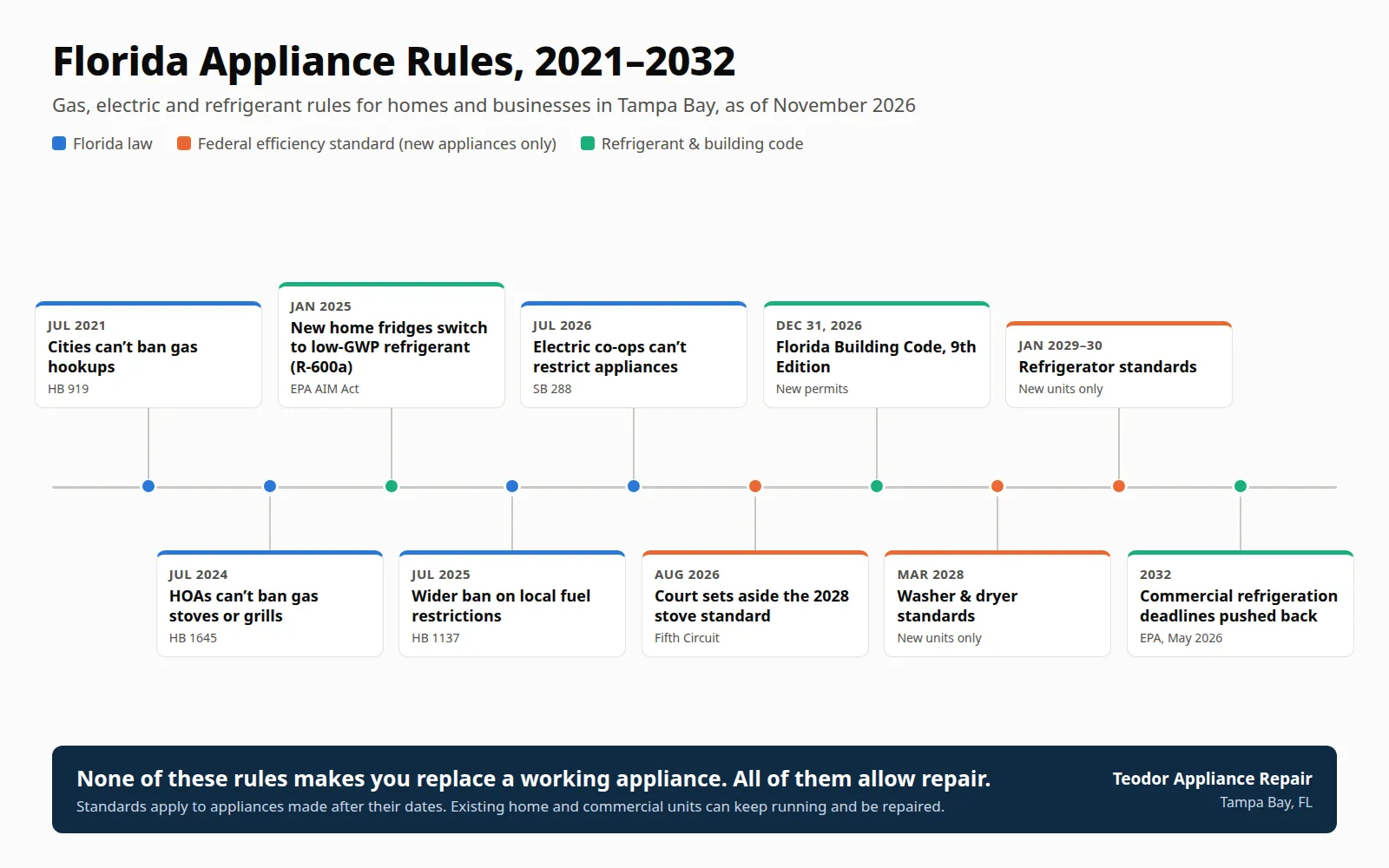
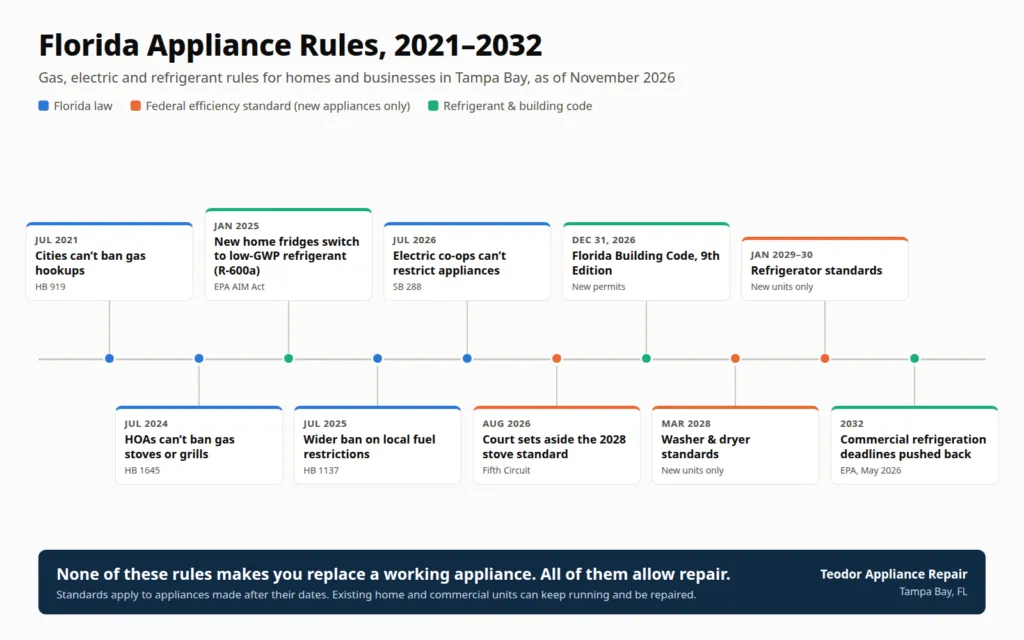
Since 2021 Florida has passed at least four laws that protect the choice between gas and electric. Each one closed a different door.
- 2021: no local gas bans (HB 919)
- Chapter 2021-150, in force since July 1, 2021, created section 366.032 of the Florida Statutes. Cities and counties may not restrict the types or fuel sources of energy that utilities may use to serve customers, which rules out local bans on new gas hookups.
- 2024: HOAs cannot ban gas appliances (HB 1645)
- In force since July 1, 2024. A homeowners association may not restrict the fuel sources supplied by utilities and LP gas dealers, or the appliances that use them, including a stove or grill.
- 2025: wider preemption (HB 1137)
- Signed May 19, 2025, in force since July 1, 2025. Local boards, agencies, commissions and other authorities may not restrict fuel sources or the appliances that use them, which closes routes around the 2021 law.
- 2026: electric cooperatives too (SB 288)
- Chapter 2026-21, signed April 1, 2026, in force since July 1, 2026. A rural electric cooperative that sells power at retail may not restrict the use of an appliance, including a stove or grill, because of the fuel it uses, and the ban now covers fees such as lot fees, developer fees and surcharges.
What it means for your appliances
- A gas range, cooktop, wall oven or dryer can be repaired, and replaced with gas again, wherever you live in Florida.
- Switching from gas to electric, or the other way, is your decision. It needs the right connection: a 240-volt circuit for most electric ranges and dryers, or a gas line installed by a licensed contractor.
- If you smell gas, turn the appliance off, open a window and call your gas company before anything else. Repair comes after the leak is made safe.
Federal Efficiency Rules: Where They Stand in November 2026
The U.S. Department of Energy sets efficiency standards for new appliances. They apply to products manufactured or imported after a compliance date. They never apply to an appliance already in your home, and they do not limit repairs.
| Appliance | Rule | Status in November 2026 | What it means for you |
|---|---|---|---|
| Ranges, cooktops, ovens | 2024 DOE standard, compliance from January 31, 2028 | Set aside by the U.S. Court of Appeals for the Fifth Circuit on August 11, 2026 | No federal 2028 limit for new stoves for now. DOE could start a new rulemaking. |
| Clothes washers and dryers | 2024 DOE standards | Published with a compliance date of March 1, 2028. In May 2025 DOE proposed rescinding the newer washer water-use limits. | Affects new machines from 2028 if it stands. Repairs are not affected. |
| Refrigerators and freezers | 2024 DOE standard | Published with compliance on January 31, 2029 or 2030, depending on the product class | Affects new models only. |
| Dishwashers | Water-use requirements | In May 2025 DOE proposed rescinding them; we could not confirm a final decision | Check before buying if water use matters to you. |
Status from the Federal Register, DOE and court reporting, checked November 17, 2026.
Two more moves could change the picture. On July 2, 2026 DOE proposed a new process rule that would add a “significant energy savings” test before any future standard could be tightened. In April 2026 the U.S. House passed H.R. 4626, 217 to 190, to limit DOE’s authority to raise standards; we found no Senate action on it.
Refrigerants: Why a New Refrigerator Is Repaired Differently
Under the EPA Technology Transitions rule, household refrigerators and freezers manufactured or imported in the U.S. from January 1, 2025 must use a refrigerant with a global warming potential below 150. Manufacturers have largely moved to R-600a (isobutane); the refrigerant is listed on the rating plate inside the fresh-food section.
- It is flammable
- R-600a is safety class A3, flammable, where the older R-134a is A1, non-flammable. A household refrigerator holds a small charge, about 57 to 150 grams, shown on the rating plate.
- Sealed-system work needs the right training and tools
- Opening the refrigerant circuit to fix a leak or replace a compressor calls for EPA Section 608 certification, hydrocarbon-specific procedures, spark-free tools and an electronic leak detector, never an open flame. Fans, boards, thermistors, defrost parts and ice makers are repaired the usual way.
- No mixing refrigerants
- An R-600a refrigerator is not converted to R-134a, and an R-134a refrigerator is not converted to R-600a. Each unit is charged with the refrigerant on its plate.
- Older refrigerators can still be serviced
- The rule covers new manufacture and import. An existing R-134a refrigerator can be repaired, although the HFC phasedown, which EPA left unchanged in 2026, can make HFC refrigerant more expensive over time.
The EPA changes finalized in May 2026 pushed back deadlines for supermarket systems and cold storage and lifted the January 1, 2026 installation deadline for residential air conditioners and heat pumps built before 2025. They did not change the final refrigerant limits.
New Technology: What Fails on Today’s Appliances
Newer appliances carry more electronics. That changes which parts fail, and in Florida heat, humidity and power surges add to the load.
- Control boards and sensors
- On the four commercial refrigerators on our commercial refrigerator page, a temperature control or thermostat had failed every time while the compressor was healthy. On a Frigidaire oven in Downtown Tampa, a control-board relay and a temperature sensor were the fault, $388 for both, as described on our Tampa oven repair page.
- Inverter compressors
- Many new refrigerators and some washers run variable-speed compressors or motors driven by an electronic board. When they stop, the board and the motor are tested together before anything is replaced.
- Induction cooktops
- Induction needs a magnetic pan. When a zone will not heat with the right pan, the power board, the induction coil or the cooling fan is the next place to look, as covered on our range and stove repair page.
- Error codes and apps
- Most new washers, dryers and ranges report a code before they stop. Write it down with the model number; it tells the technician which parts to bring. Our Kenmore washer error code guide shows how much one code can narrow the search.
Florida Building Code, 9th Edition
The 2026 Florida Building Code, 9th Edition, applies to permit applications submitted on or after December 31, 2026, according to the Florida Building Commission work plan; the City of Tampa lists January 1, 2027. Fixing a part inside an appliance is a repair. Running a new gas line, adding a 240-volt circuit or changing a dryer vent route is construction work that falls under the code and belongs to a licensed contractor with a permit where one is required. Check with your local building department before a fuel switch.
Before You Replace a Working Appliance Because of a "New Law"
- No 2026 rule requires you to retire a working gas or electric appliance.
- Efficiency standards apply to new appliances made after their dates, not to the one in your kitchen.
- Your HOA and your city cannot make you switch from gas to electric.
- A repair quote comes first. The service call is free with any repair, and we tell you plainly when replacing makes more sense.
- Our repair-or-replace calculator shows the dollar limit where a repair stops paying off.
Gas or electric, old or new: want a repair figure?
We take same-day calls across Tampa, Clearwater, St. Petersburg, Sarasota and Bradenton, 8 AM to 7 PM on weekdays and 8 AM to 6 PM on weekends.
Questions We Get About the New Rules
Is Florida banning gas stoves?
No. Florida law has protected gas since 2021, and laws passed in 2024, 2025 and 2026 extended that protection to HOAs, local boards and rural electric cooperatives. A gas stove can be repaired or replaced with gas.
Can my HOA make me switch from gas to electric?
No. Since July 1, 2024, HB 1645 bars homeowners associations from restricting fuel sources supplied by utilities and LP gas dealers, or the appliances that use them, such as a stove or grill.
Was the federal stove efficiency standard cancelled?
The U.S. Court of Appeals for the Fifth Circuit set aside DOE’s 2024 standard for ranges, cooktops and ovens on August 11, 2026, so its January 31, 2028 compliance date no longer applies. DOE could propose a new standard later.
Do I have to replace my old refrigerator because of the refrigerant rules?
No. The rule covers refrigerators manufactured or imported from 2025. An existing refrigerator can be repaired with the refrigerant on its rating plate.
Why does a new refrigerator need a different approach to repair?
Many new models use R-600a, a flammable refrigerant. Opening the sealed system calls for certification, hydrocarbon procedures and spark-free tools. Repairs outside the sealed system, such as fans, boards and defrost parts, are done the usual way.
Do I need a permit to switch from gas to electric?
Usually the new circuit or gas line is permitted work for a licensed contractor. Check with your city or county building department. Permits submitted on or after December 31, 2026 fall under the 9th Edition of the Florida Building Code.
Do I need to replace my appliances because of the 2026 rules?
No. Florida laws protect your choice of gas or electric, and federal efficiency and refrigerant rules apply to new appliances made after their dates. A working appliance can stay, and a broken one can be repaired.
Does my restaurant or bar have to replace its commercial refrigerators or ice machines?
No. Existing commercial refrigerators, prep tables, bar coolers and ice machines can keep running and be repaired. The EPA refrigerant deadlines cover newly installed or manufactured equipment, and in May 2026 EPA moved several commercial deadlines, including supermarket systems and cold storage, out to 2032.
Should a business order an appliance audit?
No law requires one. A scheduled check-up is still worth it for food safety and uptime: condenser coils cleaned, temperature controls checked, cold food held at 41°F or below, ice machines descaled. We service commercial refrigeration monthly and ice machines every 3 or 6 months, on terms agreed with each business.
When does replacing make more sense than repairing?
When the repair approaches the value of the machine, when an older unit has a sealed-system failure, or when you are remodeling. We give the price before any work begins, the service call is free with any repair, and we say plainly when replacing makes more sense.
Sources
Florida: Chapter 2021-150 (HB 919); 2024 Senate summary of HB 1645; HB 1137 (2025) bill summary; SB 288 (2026) bill summary and bill history, Chapter 2026-21.
Federal: Fifth Circuit decision on the cooking-product standard; DOE washer and dryer standards; DOE refrigerator standard; Columbia Law tracker of DOE actions.
Refrigerants: EPA Technology Transitions restrictions by sector; May 26, 2026 reconsideration rule. Building code: Florida Building Commission work plan.

Andrew Teodor — Owner of Teodor Appliance Repair, with offices in Tampa, Bradenton, Clearwater, Sarasota and St. Petersburg. The repair examples on this page come from our own service records.
$25 OFF
with Online Application