
Repairing vs. Replacing Home Appliances in Tampa Bay (2026–2027)
An Analysis Based on 2,486 Real Service Calls
When your refrigerator stops cooling in Tampa or your washing machine refuses to drain in Sarasota, you face a strictly mathematical question: do you call a technician, drive to a big-box showroom for a brand-new unit, or browse local listings for a used appliance? Most online advice relies on outdated national averages that ignore both 2026–2027 retail pricing and the brutal realities of Florida’s climate.
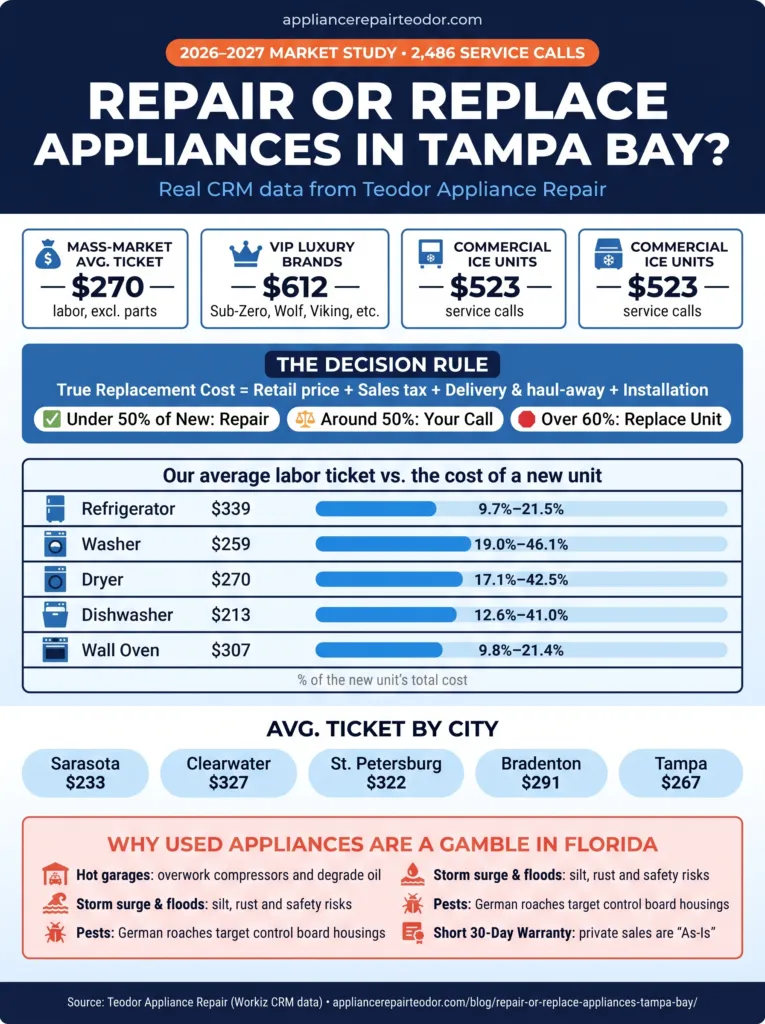
I have run Teodor Appliance Repair for over 10 years. Instead of relying on abstract theories, I opened our internal Workiz CRM system and pulled our service data for a full 12-month period — from September 1, 2025, through August 31, 2026. During that window, our team completed 2,486 service calls across the Tampa Bay region.
In this guide, I will break down the real economics of appliance repair (where our average ticket is calculated as the total invoice minus replacement parts — representing the pure cost of professional labor and technical execution) and compare it directly against the true cost of buying new or used equipment. No fluff, no marketing cliches, and no fabricated stories — just hard numbers, mechanical realities, and pragmatic math.
The Tampa Bay Market Snapshot (2025–2026): What Our 2,486 Completed Jobs Show
To decide whether an appliance is worth fixing, you first need an accurate baseline of repair costs. Out of the 2,486 jobs we completed over the past year, 2,342 involved standard, mass-market residential appliances. The average ticket (labor excluding parts) across that entire segment was $270.
High-end luxury appliances (VIP brands such as Sub-Zero, Thermador, Viking, Wolf, and GE Monogram) form a separate tier. We completed 85 luxury service calls with an average ticket of $612 — 2.3 times higher than mass-market units. Another 59 service calls involved commercial ice machines (Commercial Ice), averaging $523.
When we break down our service calls across the five core areas of the Tampa Bay region, the market snapshot looks like this:
| Service Area | Completed Jobs | Average Ticket (Labor Excl. Parts) | Recall Rate (%) | Diagnostic-Only Visits (%) | Mass-Market Refrigerator Average Ticket |
|---|---|---|---|---|---|
| Tampa | 409 | $267 | 9.8% | 44.7% | $311 (97 jobs) |
| Clearwater | 533 | $327 | 9.2% | 36.0% | $352 (182 jobs) |
| St. Petersburg | 499 | $322 | 9.2% | 33.7% | $391 (131 jobs) |
| Bradenton | 448 | $291 | 6.2% | 37.3% | $353 (125 jobs) |
| Sarasota | 584 | $233 | 8.6% | 49.1% | $283 (146 jobs) |
Local technicians: appliance repair in Tampa, FL, refrigerator and appliance repair in Clearwater, St. Petersburg appliance repair services, local appliance repair in Bradenton and appliance repair in Sarasota and Longboat Key.
Several specific ZIP codes in the region also stand out with the highest average tickets:
- Clearwater (33762): $550
- Clearwater (33767): $549
- St. Petersburg (33701): $464
- St. Petersburg (33704): $453
- Longboat Key (34228): $429
How Florida’s Climate Accelerates Appliance Wear and Tear
Over 10 years of operating in Florida, one thing has become unmistakable: appliances here run under continuous environmental stress. In my professional assessment as a service company owner, three regional factors significantly accelerate mechanical and electronic wear in Tampa Bay compared to northern or arid states:
- High Heat and Humidity
- According to NOAA 1991–2020 climate normals for Tampa, the average daily high temperature in July and August reaches 91°F (32.8°C), while average relative humidity stays between 79% and 81% (climbing to 83% in September) (WeatherBlaze). Furthermore, instrumental monitoring by the Florida Solar Energy Center (FSEC / University of Central Florida) shows that temperatures inside unconditioned residential garages in Florida consistently exceed outdoor ambient air in the summer, remaining above 90°F (32.2°C+) during peak late-afternoon hours (5:00 PM–6:00 PM). When a secondary refrigerator or freezer is placed in a hot garage, the condenser coils and compressor operate under extreme thermal load, oil degrades faster, and motor windings overheat.
- Coastal Salt Air
- In coastal ZIP codes (such as Clearwater 33767 or Longboat Key 34228), our field observations show that microscopic sea salt particles suspended in humid air accelerate electrochemical corrosion. This degrades terminals on main control boards, temperature thermistors, and aluminum evaporator tubing, leading to pinhole refrigerant leaks.
- Hard Water and Summer Lightning Storms
- In our day-to-day field experience, mineral-heavy municipal water across the bay area clogs water inlet valve screens on washers and dishwashers and wears down pump seals. Meanwhile, Florida’s daily summer thunderstorms trigger voltage spikes and brownouts that damage sensitive inverter boards in modern appliances.
Our Decision Rule: Hard Math Over Age Myths
Consumer guides frequently cite the classic “50% rule” (or “50/50 rule”): if a repair costs more than 50% of the price of a new appliance — especially once the unit is past half of its expected lifespan — you should replace it. However, industry analysts emphasize that calendar age alone is a poor metric; the nature of the failure and the structural condition of the machine matter far more.
Based on our 2,486 completed service calls over the past year, we use a practical, transparent decision framework:
- Condition Beats Calendar Age
- A 10-year-old direct-drive washing machine with a solid tub and zero shaft corrosion will outlast a 3-year-old budget machine with a cracked drum spider arm. We evaluate the core mechanical platform, cabinet integrity, wiring harness, and hydraulics.
- The 50% Threshold
- If the total repair cost approaches half (50%) of the total cost of a comparable new model, we lay out both scenarios honestly and let the homeowner make the final call.
- The 60%+ Threshold
- If a repair exceeds 60% of the price of a comparable new unit, we advise against repairing and recommend putting that money toward a replacement.
Total Replacement Cost
We never compare a repair quote against a bare retail sticker price. In Tampa Bay, the real cost of replacing an appliance includes four components:
- Retail price of the new unit.
- Florida Sales Tax (2026 rates). Florida levies a 6% state sales tax plus a county discretionary sales surtax (applied to the first $5,000 of a single item’s purchase price per Florida Department of Revenue Form DR-15DSS and Xero US Tax Guide). In 2026, the combined tax rates across our service area are:
Hillsborough County (Tampa): 7.5% (6% state + 1.5% surtax);
Pinellas County (Clearwater, St. Petersburg): 7.0% (6% state + 1.0% surtax);
Manatee County (Bradenton): 7.0% (6% state + 1.0% surtax per Avalara);
Sarasota County (Sarasota): 7.0% (6% state + 1.0% surtax per Avalara). - Delivery and Old Appliance Haul-Away. At major retailers (The Home Depot, Lowe’s, Best Buy), standard delivery runs $29–$50 (or free on qualifying promotional orders, such as $998+ at The Home Depot), while hauling away the old appliance costs $25–$50 per unit (and typically requires the homeowner to disconnect gas or water lines beforehand per Shoals Guide and Dropcurb).
- Professional Installation Labor & Hookup Kits. According to 2026 HomeGuide data, professional installation labor runs $75–$200 for a refrigerator, $100–$300 for a washer, dryer, or freestanding range, $150–$370 for a cooktop, $150–$300 for a built-in wall oven, and $200–$500 for a built-in dishwasher.
Breakdown by Appliance Type: Mass-Market Repair vs. True Replacement Cost
By 2026–2027, the new appliance market has fully transitioned to complex digital control boards, variable-speed inverter motors, and R-600a (isobutane) hydrocarbon refrigerant — approved under the EPA SNAP program to replace R-134a in household refrigerators and freezers, requiring strict non-sparking, flameless service procedures during sealed-system repairs (R-600a Technical Guide).
Below, we compare our average labor ticket per category against current retail prices at The Home Depot and regional Florida retailers (such as Famous Tate), calculating the percentage of our labor ticket relative to the full replacement cost (using a 7% sales tax plus $80 for basic delivery/haul-away, or standard installation labor for built-in units):
| Appliance Type (Mass-Market) | Completed Jobs (Workiz) | Average Labor Ticket | 2026 Retail Price Range (New Unit) | Total Replacement Cost (Incl. 7% Tax & Basic Delivery/Install) | Labor Ticket as % of Total Replacement Cost |
|---|---|---|---|---|---|
| Refrigerator (French Door) | 685 | $339 | $1,399 – $3,199 | $1,577 – $3,503 | 9.7% – 21.5% |
| Washer (Full-Size) | 648 | $259 | $450 – $1,200 | $562 – $1,364 | 19.0% – 46.1% |
| Dryer (Full-Size) | 335 | $270 | $519 – $1,399 | $635 – $1,577 | 17.1% – 42.5% |
| Dishwasher (24" Built-In) | 238 | $213 | $299 – $1,399 | $520 – $1,697 (incl. $200 min. install) | 12.6% – 41.0% |
| Oven (Built-In Wall Oven) | 99 | $307 | $1,199 – $2,799 | $1,433 – $3,145 (incl. $150 min. install) | 9.8% – 21.4% |
| Ice-Maker (Standalone/Built-In) | 60 | $302 | $395 – $2,999 | $503 – $3,289 | 9.2% – 60.0% |
| Stove / Range (30" Freestanding) | 50 / 19 | $232 / $319 | $599 – $1,299 | $721 – $1,470 | 15.8% – 44.2% |
| Freezer (Chest / Upright) | 36 | $271 | $199 – $1,300 | $293 – $1,471 | 18.4% – 92.5% |
| Cooktop (30"–36" Surface) | 28 | $246 | $380 – $1,699 | $557 – $1,968 (incl. $150 min. install) | 12.5% – 44.2% |
| Wine Cooler (Built-In/Freestanding) | 21 | $344 | $431 – $1,699 | $541 – $1,898 | 18.1% – 63.6% |
1. Refrigerators — 685 Jobs, $339 Average Ticket
The refrigerator is the most expensive and urgent appliance in a Florida home. In The Home Depot’s French Door catalog, mainstream models (LG, Samsung, GE, Frigidaire) start at $1,399–$1,499 for basic 3-door units and range up to $1,999–$3,199 for full-featured models with dual ice makers (while compact top- or bottom-freezer units like Vissani start at $499–$799 in the general refrigerator catalog).
- Common Failure Mechanisms
- Evaporator or condenser fan motor failures, defrost system malfunctions (defrost heater, bi-metal thermostat, or sensor), clogged defrost drain lines, ice maker assembly failures, and inverter control board burnouts.
- The Math
- Buying a new French Door refrigerator ($1,399–$3,199) with 7% sales tax and $80 for delivery/haul-away brings your total out-of-pocket replacement cost to $1,577–$3,503. Our average labor ticket ($339) represents just 9.7% to 21.5% of the replacement cost. Even after adding the price of an OEM fan motor or control board, the total repair bill stays well below the 50% threshold. The primary exception is a sealed-system refrigerant leak or compressor failure on an older budget unit, where the combined labor and parts estimate can cross the 60% mark.
2. Washing Machines (Washers) — 648 Jobs, $259 Average Ticket
Washers are the second most common call in our database. Full-size washing machines at Florida retailers and The Home Depot generally range from $450 to $1,200 for mainstream top-load and front-load models (with high-capacity premium models reaching $2,000).
- Common Failure Mechanisms
- Clogged or burned-out drain pumps, worn tub suspension systems (shock absorbers on front-loaders or suspension rods on top-loaders that cause violent spinning out-of-balance errors), failed door lock latches, and clogged water inlet valves.
- The Math
- Including 7% tax and $80 for delivery and haul-away, a new washer costs $562–$1,364. Our $259 average labor ticket equals 19.0% to 46.1% of a replacement unit (and for a mid-range $850 washer totaling $990 with tax and delivery, labor is just 26.2%). Replacing a drain pump, inlet valve, or suspension rod set makes clear financial sense. We advise replacement primarily when the rear drum bearing seizes or the inner basket spider arm corrodes, pushing the total repair past 60% of a new unit.
3. Dryers — 335 Jobs, $270 Average Ticket
Mechanically, a clothes dryer is one of the simplest and longest-lasting appliances in your home. Retail prices for full-size electric and gas dryers (Amana, Whirlpool, LG, Samsung, GE) at The Home Depot run from $519–$549 for entry-level units up to $729–$1,399 for steam and sensor-dry models.
- Common Failure Mechanisms
- Burned-out heating elements or blown thermal fuses caused by lint-restricted house exhaust vents, as well as worn drum support rollers, idler pulleys, and drive belts.
- The Math
- Against a total replacement cost of $635–$1,577, our $270 average labor ticket is 17.1% to 42.5%. Installing a complete mechanical maintenance kit (rollers, belt, idler pulley) or replacing a heating element restores a dryer for years at a fraction of replacement cost.
4. Dishwashers — 238 Jobs, $213 Average Ticket
Dishwashers carry the lowest average labor ticket in our CRM at $213. At The Home Depot, 24-inch built-in dishwashers range from $299–$429 (entry-level plastic-tub models from Frigidaire, GE, and Samsung) to $599–$1,399 (stainless-steel tub models from Maytag, Whirlpool, LG, KitchenAid, and Bosch 800 Series). However, replacing a built-in dishwasher involves a hidden expense: according to 2026 HomeGuide figures, professional installation labor (plumbing, drain line, and electrical hardwiring) adds $200 to $500.
- Common Failure Mechanisms
- Wash circulation pump or drain pump failure, leaking door gaskets or pump seals, and control panel malfunctions caused by steam intrusion.
- The Math
- If you buy a mid-range $650 dishwasher, add 7% tax ($45.50), and pay a modest $200 installation fee, your real replacement cost is $895.50. A $213 labor ticket represents just 23.8% of that total. As long as the tub isn’t leaking and the racks aren’t rusted through, repairing is faster and significantly cheaper than paying for a new unit plus installation labor.
5. Ovens, Stoves, Cooktops & Ranges (Ovens — 99 / $307, Stoves — 50 / $232, Cooktops — 28 / $246, Ranges — 19 / $319)
Cooking appliances have heavy-gauge steel cabinets and insulation that last for decades. According to current Home Depot catalogs and HomeGuide installation data:
- Freestanding 30-inch Stoves / Electric & Gas Ranges cost $599–$649 (Amana, basic GE, Frigidaire) up to $749–$1,299 (Samsung, LG, GE with convection and double ovens), plus $100–$300 for installation.
- Built-in Wall Ovens run $1,199–$1,599 for single ovens (Whirlpool, Frigidaire, GE) and $1,999–$2,799+ for double or combination wall ovens, plus $150–$300 for cabinet removal and installation.
- Cooktops (30″–36″) from major brands (Whirlpool, GE, Frigidaire) cost $380–$579 up to $1,099–$1,699 (with downdraft models reaching $2,199–$2,299), plus $150–$370 for professional hookup.
- Common Failure Mechanisms
- In gas ovens, the glow bar igniter weakens over time and fails to draw enough current to open the safety gas valve. In electric units, bake or broil elements burn out, temperature probes drift out of resistance range, or high-amperage relays burn on the control board.
- The Math
- With average labor tickets between $232 and $319 (which equals just 9.8%–21.4% of the total replacement cost of a wall oven and 12.5%–44.2% for cooktops and ranges), replacing an igniter, heating element, or relay board is, in our professional assessment, financially justified in the vast majority of service calls.
6. Specialty Appliances: Ice Makers, Freezers & Wine Coolers (Ice-makers — 60 / $302, Freezers — 36 / $271, Wine coolers — 21 / $344)
In Florida’s climate, standalone ice makers and wine coolers are kitchen and lanai staples. According to The Home Depot’s catalog:
- Undercounter built-in and freestanding Ice Makers range from $395–$786 for entry-level units up to $2,159–$2,999 for built-in KitchenAid and Ca’Lefort machines. (Portable countertop ice makers priced at $69–$290 are disposable and not economical to repair).
- Compressor-driven Wine Coolers (28 to 164 bottles) cost $431–$699 for mid-tier units and $1,100–$1,699 for built-in dual-zone units (with large wine cellars reaching $2,129–$2,999).
- Freezers: Small 5–7 cu. ft. chest freezers cost just $199–$495, whereas full-size upright freezers run up to $1,300. At an average labor ticket of $271, repairing makes financial sense for full-size upright freezers, built-in ice makers, and dual-zone wine coolers, whereas a $199 compact chest freezer should simply be replaced if it suffers a major failure.
Mass-Market Brand Breakdown (Our 12-Month CRM Data)
Here are the exact numbers from our Workiz database over the past year across the most common residential brands (completed jobs and average labor ticket excluding parts):
| Brand | Completed Jobs | Average Labor Ticket |
|---|---|---|
| Whirlpool | 294 | $274 |
| GE | 278 | $278 |
| LG | 261 | $283 |
| Samsung | 249 | $301 |
| Maytag | 139 | $245 |
| Frigidaire | 115 | $278 |
| Kenmore | 91 | $257 |
| KitchenAid | 57 | $393 |
| Bosch | 49 | $284 |
These figures give Tampa Bay homeowners an objective benchmark of baseline service labor across major appliance platforms.
The VIP Luxury Segment (Sub-Zero, Thermador, Viking, Wolf, GE Monogram): Why the Math Is Completely Different
As our CRM data shows, the average labor ticket for VIP luxury appliances is $612 (across 85 completed jobs), which is 2.3 times higher than standard residential brands. Broken down by appliance type, our luxury numbers look like this:
| Appliance | Completed Jobs | Average Ticket |
|---|---|---|
| Refrigerator | 44 | $556 |
| Oven | 15 | $746 |
| Freezer | 6 | $868 |
| Dishwasher | 5 | $663 |
| Range | 4 | $759 |
| Cooktop | 1 | $1,516 |
To a homeowner with a standard refrigerator, a $556–$868 labor bill sounds steep. But in the luxury segment, the financial equation operates on a completely different scale:
- The Price of New Luxury Equipment
- According to Yale Appliance’s 2026 pricing guide and authorized dealer catalogs (Town Appliance), a new built-in Sub-Zero refrigerator costs $8,200–$10,800 for a single Designer Column, $11,600–$16,800+ for the Classic Series, and $15,800–$21,630 for the Pro Series. Professional Viking ranges on the manufacturer’s official site start at $4,779–$6,549 for 30-inch models and climb to $17,599–$26,489 for 48-inch and 60-inch configurations, while Wolf ranges (36″–48″) in 2026 retail between $12,000 and $28,000.
- Repair-to-Replacement Ratio
- According to specialized Sub-Zero service data (Wilshire Refrigeration), minor repairs (ice makers, door gaskets, thermostats) typically total $200–$500, compressor replacements run $500–$1,500, and a full sealed-system rebuild (evaporator, compressor, drier) runs $2,000–$3,000. With our average labor tickets of $556–$759, even a major component overhaul represents only 5% to 15% of the cost of a new unit. Under our 50%–60% threshold rule, repairing a luxury appliance under 15–20 years old is almost always the smartest financial move.
- Custom Cabinetry and Installation Costs
- Luxury appliances are flush-mounted into custom cabinetry with matching wood panels. Basic installation for a new built-in refrigerator starts around $500, and if cutout dimensions or hinge clearances have changed over the past 15 years, replacing the unit forces thousands of dollars in custom cabinet modifications. Repairing preserves your existing kitchen architecture.
Used & Refurbished Appliances in Florida: Smart Savings or a Gamble?
When repairing an old appliance exceeds 60% of the price of a new one, budget-conscious homeowners often look at used or refurbished equipment. According to local used appliance dealers in Tampa (such as Tampa Used Appliances & Repair), starting prices for inspected used dishwashers begin at $125, while used washers and refrigerators start at $275 (advertising up to 65% off new retail prices).
However, based on my professional experience visiting homeowners who bought secondhand appliances from private online sellers, the used market in Florida carries four major risks:
1. Hidden Defects and Temporary Symptom Masking
In our field experience, private peer-to-peer marketplaces are rife with temporary fixes that mask underlying failures. If a refrigerator has a slow refrigerant leak inside the foamed cabinet walls or an intermittent main board fault, it may cool fine during a 10-minute driveway inspection, only to fail completely a few weeks later — leaving the buyer with a repair bill that exceeds what they paid for the machine.
2. The Risk of Flood-Damaged Appliances After Hurricanes
Tampa Bay frequently experiences tropical storms and storm-surge flooding. According to official warnings from FEMA (Publication P-234 Repairing Your Flooded Home), the Gas Appliance Manufacturers Association (GAMA), and NC State Extension, appliances exposed to floodwaters pose severe fire, explosion (in gas valves), and shock hazards due to internal corrosion and silt trapped inside switches and controls — even after the exterior dries out and appears to run. Furthermore, refrigerators and freezers with wet foam insulation cannot be sanitized or salvaged and must be discarded. Buying a used appliance from an unverified private seller after storm season carries a real risk of bringing a flood-damaged unit into your home.
3. Biological Hazards (Pests Inside Electronics)
According to entomology publications from the University of Florida (UF/IFAS Extension) and NC State Extension, German cockroaches actively target heat-generating appliances with access to moisture and condensation: motor compartments behind refrigerators and freezers, ovens, ranges, dishwashers, and electrical junction boxes. UF/IFAS specialists explicitly advise inspecting items for pheromone odors and droppings before bringing them indoors. In our service practice, roach infestations inside warm control board housings not only introduce pests into your kitchen but also short out circuit board traces.
4. Limited Warranties or "As-Is" Sales
Private sellers on online marketplaces sell appliances strictly “As-Is” with zero recourse. Even established brick-and-mortar used appliance stores in Tampa typically include a standard warranty of just 30 days (Tampa Used Appliances & Repair).
When Buying Used Makes Sense — and When It Doesn't
Buying used makes sense if:
- You are buying a mechanically simple, electromechanical Dryer or a basic Top-Load Washer without complex inverter electronics.
- You only need a temporary bridge solution for a few months (for example, during a kitchen remodel or before selling a property).
- You purchase from a brick-and-mortar dealer with in-house technicians who test the unit, offer at least a 30-day warranty, and provide free haul-away of your broken unit.
Buying used does NOT make sense (repair yours or buy new instead):
- Modern French Door Refrigerators with complex electronics and R-600a sealed systems. The risk of inheriting a hidden sealed-system leak or moisture-damaged insulation is too high. If your own refrigerator breaks down, with our average labor ticket of $339, it is far safer to repair the unit whose history you know from day one.
- Dishwashers. In our service experience, used dishwashers sitting dry in storage often suffer from dried-out rubber sump seals and gaskets, increasing the risk of kitchen floor leaks once reconnected to water pressure. Given our $213 average repair ticket (or brand-new entry-level dishwashers starting at $299–$399 at Home Depot), buying a used dishwasher is rarely worth the risk.
5-Minute Homeowner Checklist: How to Make the Right Call
Before ordering a replacement online or booking a technician, run through these five steps:
- 1. Calculate the True Replacement Cost. Look up a comparable new model online, add your county sales tax (7.5% in Hillsborough or 7.0% in Pinellas, Manatee, and Sarasota), delivery ($29–$50), haul-away ($25–$50), and professional installation labor ($75–$500 depending on the appliance). Write down that final number.
- 2. Evaluate Physical Condition (Not Calendar Age!). Is the frame or tub free of structural rust? Has the unit ever been exposed to standing floodwater? If the cabinet, tub, and insulation are sound, the machine is a candidate for repair.
- 3. Compare the Repair Against Our Average Ticket. Across mass-market brands in Tampa Bay, professional labor averages between $213 (dishwashers) and $339 (refrigerators) plus the part. If the total repair stays under 50% of your True Replacement Cost from Step 1, repairing is financially rational. Over 60%, we recommend replacing.
- 4. Check Your Brand Tier. If you own Sub-Zero, Wolf, Thermador, Viking, or GE Monogram, always start with a professional diagnostic. When new units retail from $8,200 to over $26,000, an average labor ticket of $612 restores your equipment for a small fraction of replacement cost.
- 5. Avoid Impulse Purchases of Unverified Used Appliances. Don’t trade your repairable appliance with a known history for an unverified secondhand machine that may have run in an overheated garage, suffered flood exposure, or harbored pests in its control boards.
Not sure whether to repair or replace?
We take same-day calls across Tampa, Clearwater, St. Petersburg, Sarasota and Bradenton, 8 AM to 7 PM, seven days a week.
Frequently Asked Questions (FAQ)
How much does appliance repair cost on average in Tampa Bay in 2026?
Based on our database of 2,486 completed service calls in 2025–2026, the average labor ticket (excluding replacement parts) for standard mass-market appliances is $270. By appliance category, dishwashers ($213) and stoves ($232) have the lowest average labor cost, followed by cooktops ($246), washers ($259), dryers ($270), and freezers ($271). The highest average tickets in the standard segment are for ice makers ($302), wall ovens ($307), freestanding ranges ($319), refrigerators ($339), and wine coolers ($344).
When is it better to replace an appliance rather than repair it?
We use percentage thresholds based on the total replacement cost of a comparable new unit (including 7%–7.5% sales tax, delivery, installation labor, and haul-away). If a repair costs around 50% of that total, we explain the pros and cons transparently and leave the choice to you. If the repair estimate exceeds 60% of the total price of a new unit — or if the cabinet or insulation has irreversible structural damage — we advise buying a new appliance.
Why do Sub-Zero refrigerators and Wolf ranges cost more to repair than standard brands?
In our CRM data, the average labor ticket for VIP luxury brands is $612 (specifically $556 for refrigerators, $663 for dishwashers, $746 for ovens, $759 for pro ranges, and $868 for freezers) — 2.3 times higher than mass-market units. This reflects complex built-in engineering, dual sealed refrigeration systems, heavy-duty components, and precision handling around custom cabinetry. However, compared to the retail price of a new Sub-Zero ($11,600–$21,630) or Wolf range ($12,000–$28,000), repairing represents only a minor fraction of replacement cost.
Is it worth buying a used refrigerator in Florida instead of repairing my old one?
For modern refrigerators, we advise against buying unverified secondhand units from private sellers. Due to Florida’s heat and humidity, the risk of flood-damaged appliances entering the resale market, and pest infestations inside warm motor compartments, private used purchases are a gamble. Even at brick-and-mortar used appliance shops in Tampa, refrigerators start at $275 with only a 30-day warranty — comparable to our $339 average labor ticket to repair your existing refrigerator whose history you already know.
What do your service call statistics and average tickets look like across different Tampa Bay cities?
According to our 12-month CRM data (2,486 total jobs), the breakdown across our five primary zones is as follows: Sarasota recorded 584 jobs ($233 average ticket, 8.6% recall rate, 49.1% diagnostic-only visits); Clearwater recorded 533 jobs ($327 average ticket, 9.2% recall rate, 36.0% diagnostic-only); St. Petersburg recorded 499 jobs ($322 average ticket, 9.2% recall rate, 33.7% diagnostic-only); Bradenton recorded 448 jobs ($291 average ticket, 6.2% recall rate, 37.3% diagnostic-only); and Tampa recorded 409 jobs ($267 average ticket, 9.8% recall rate, 44.7% diagnostic-only).
Which mass-market appliance brands have the lowest and highest average repair tickets?
Among the most common brands in our annual sample, Maytag ($245 across 139 jobs) and Kenmore ($257 across 91 jobs) recorded the lowest average labor tickets. The middle tier includes Whirlpool ($274 / 294 jobs), GE ($278 / 278 jobs), Frigidaire ($278 / 115 jobs), LG ($283 / 261 jobs), and Bosch ($284 / 49 jobs). The highest average tickets in the non-VIP segment were recorded for Samsung ($301 / 249 jobs) and KitchenAid ($393 / 57 jobs).
Don’t Wait for a Breakdown: Check Your Appliances at Least Every Two Years
Every number in this guide points to the same conclusion: appliances are cheapest to fix while the problem is still small. A worn door gasket, a partly blocked drain line, a tired fan motor, a lint-packed dryer vent or a dusty condenser coil is a modest repair today. Left alone, the same fault tends to damage other parts, and in Florida’s heat, humidity and salt air it happens faster.
That is why I recommend a professional check-up of your major appliances — refrigerator, washer, dryer, dishwasher, oven and range — at least once every two years. A technician can test the parts that wear out first, clean what needs cleaning, and tell you honestly whether the machine still has years of service left or is getting close to the 50–60% point where replacing makes more sense. Planned monitoring is almost always cheaper than an emergency repair, a refrigerator full of spoiled food or a flooded laundry room.
A small check now is far better than overpaying for a big repair later. Book a technician below and we will look at your appliances before they turn into expensive problems.
$25 OFF
with Online Application