

Miele is one of the most trusted premium appliance brands for a reason — its dryers are engineered for efficiency, quiet operation, and fabric care. But that same sophistication means a heating problem is rarely as simple as “the heating element burned out.” As a trusted appliance repair Tampa Bay provider, we break down below why your Miele dryer isn’t heating, what you can check yourself, and when it’s time to call in a professional.
For expert diagnostics and same-day service, trust our certified technicians specializing in appliance repair Tampa.
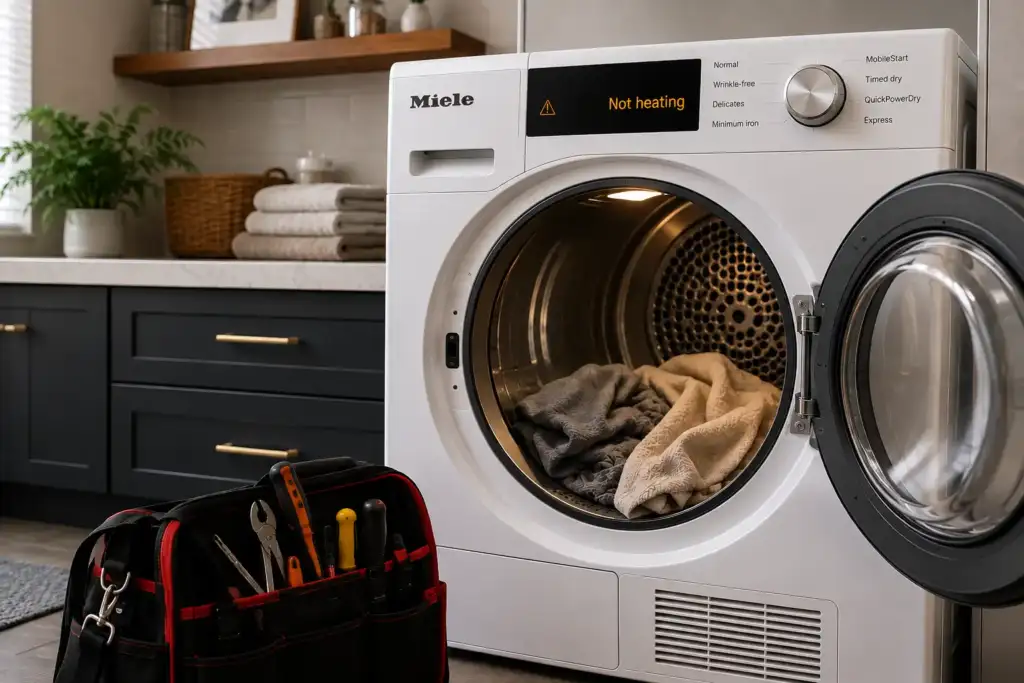
How Miele Dryers Generate Heat
Most modern Miele dryers use heat pump technology instead of a traditional heating element. Rather than burning electricity to generate heat directly, a heat pump dryer recycles warm air through a refrigerant-based condenser system, extracting moisture and reheating the air in a closed loop. This makes Miele dryers significantly more energy-efficient than conventional vented dryers, and it’s why they run cooler to the touch and use less electricity per cycle.
The tradeoff is complexity. Heating issues in a heat pump dryer are more often tied to airflow, filters, and the condenser system than a simple broken heating coil — though some vented Miele models do use a conventional heating element, which can fail on its own like any standard dryer. Understanding which type you own is the first step in narrowing down the cause.
Common Reasons Your Miele Dryer Isn’t Heating
1. Clogged lint filter or condenser
This is the single most common cause, by far. A blocked lint filter or a dirty heat exchanger/condenser restricts airflow, which can trigger the dryer to reduce or stop heat production entirely as a built-in safety measure. Miele recommends cleaning both the lint filter and condenser regularly — a task that’s easy to overlook, especially since heat pump dryers don’t vent lint outside the way traditional dryers do, so buildup happens internally and out of sight.
2. Restricted or blocked venting
Even heat pump models rely on some internal airflow to operate correctly, and vented Miele models depend on it entirely. A crushed, clogged, kinked, or overly long vent line can cause overheating protection to kick in, cutting off the heat cycle even though the drum keeps turning normally.
3. Failed heating element (vented models)
If you have a conventional vented Miele dryer, a burnt-out heating element is a common culprit. The drum will still tumble since the motor operates independently of the heating circuit, but no warm air will be produced. Heating elements typically fail due to age, power surges, or repeated overheating events.
4. Heat pump or compressor failure
On heat pump models, a failing compressor, refrigerant leak, or faulty condenser fan can prevent the system from generating heat, even though every other function of the dryer appears to work normally. This is one of the more complex failures and almost always requires a technician with refrigerant-handling experience.
5. Thermal fuse or thermostat has tripped
A safety thermal fuse can blow if the dryer overheats due to blocked airflow, cutting power to the heating system entirely as a protective measure. Once tripped, most thermal fuses need to be physically replaced — they don’t reset on their own, even after the underlying airflow issue is fixed.
6. Door switch or sensor malfunction
Miele dryers won’t run a heating cycle if the door safety switch or an internal sensor isn’t registering correctly, even if the door appears to be closed properly. A worn or misaligned switch can silently block the heating function while the rest of the cycle runs as normal.
7. Faulty control board
Less common but still possible, a failing control board can miscommunicate with the heating or heat pump system, causing the dryer to run a full cycle with no heat despite every individual component technically working.
8. Error codes
Miele dryers often display a specific fault code (commonly starting with F) when a heating-related component fails. These codes point directly to the affected part — such as the heat pump, temperature sensor, condenser, or control board — and are one of the fastest ways for a technician to diagnose the issue accurately without guesswork.
What to Check Before Calling for Repair
- Clean the lint filter thoroughly — Miele recommends doing this after every single cycle, not just occasionally.
- Clean the condenser unit, following your model’s manual instructions, since a clogged condenser is the most frequent cause of heating loss on heat pump models.
- Check the vent line for kinks, blockages, or lint buildup if you have a vented model, and make sure the exterior vent flap isn’t stuck closed.
- Confirm the door is closing and latching fully, and check for visible wear or damage to the door switch mechanism.
- Note any error code displayed on the panel, along with when it appears in the cycle — this will help a technician diagnose the issue faster and arrive with the right part.
- Avoid overloading the dryer, which can restrict airflow around the drum and trigger heat-related safety shutoffs.
- Check your circuit breaker, since a partial power issue can sometimes affect the heating circuit while leaving the motor unaffected.
If the dryer still won’t heat after these checks — especially if there’s a persistent error code, a burning smell, unusual noises from the compressor, or visible moisture pooling near the unit — it’s time to call a professional rather than continue troubleshooting on your own.
Signs You Need Professional Repair, Not a DIY Fix
Certain symptoms are strong indicators that the issue is beyond a simple cleaning fix: a recurring or persistent error code even after resetting the dryer, a burning or chemical smell (which can indicate a refrigerant leak in heat pump models), the compressor cycling on and off rapidly or making grinding noises, or heat that starts strong but fades partway through the cycle. Heat pump systems in particular involve sealed refrigerant components that should only be serviced by a trained technician.
When to Call a Professional
Heat pump systems, refrigerant components, and control boards aren’t something to troubleshoot without the right tools — attempting a DIY fix on these parts can cause further damage, create a safety hazard, or void your manufacturer warranty. A trained technician can accurately diagnose whether the issue is airflow, a mechanical failure, or an electronic fault, and repair it correctly the first time.
Teodor Appliance Repair offers expert Miele dryer repair, with technicians experienced specifically in Miele’s heat pump and vented dryer systems, from routine condenser servicing to full compressor replacement.
FAQ
OTHER ARTICLES
Get Your Miele Dryer Heating Again
Don’t let a cold, damp load become a bigger problem. Call Teodor Appliance Repair at (863) 594-1784, or book your Miele dryer repair online for fast, professional service across Tampa and the greater Tampa Bay area. Our technicians arrive fully equipped to diagnose and repair most Miele dryer issues in a single visit, backed by a 90-day warranty on all work. R
each out today and get your dryer back to full performance before laundry piles up any further.